8 corporate travel trends to watch in 2026

2026 is underway, and there are a few shifts in corporate travel worth keeping an eye on.
Global Business Travel Association (GBTA) is predicting global business travel spend to hit about US $1.69 trillion in 2026, though growth is uneven and many companies are moving into the new year with a few hangovers from last year.
No one can predict the full year with total certainty, but here’s what we’re seeing so far in business travel. Trends include:
- AI gets practical
- Traveller wellbeing becomes a KPI
- Duty of care stays centre stage
Trend 1: Sustainability receipts, please
Across global markets, choosing greener options and reporting on results is now a mandate. According to Business Travel News, 20% of travel buyers have specific carbon-reduction targets tied to business travel activity. Meanwhile, nearly 60% of travellers are concerned about the carbon footprint of their work trips, influencing how they book and behave.
In the EU, especially, the Corporate Sustainability Reporting Directive (CSRD) has raised the bar. Companies must now disclose Scope 3 emissions, bringing flights, accommodation, and ground transport under scrutiny. FCM Consulting is already seeing carbon budgets, supplier scorecards, and rail alternatives built into corporate travel program design.
Across the globe, governments are introducing their own regulations, forcing companies to produce more accurate emissions data and take more accountability for their output. Throughout 2026, we’ll see greater transparency and stronger government pressure. More businesses will rely on tech to measure the carbon impact of every trip, and travellers will actively choose lower-emission transport and lodging options when given the option.


Trend 2: AI gets practical
We won’t bang on about artificial intelligence (AI) - it’s everywhere - but in 2026 it’s moving from hype to everyday necessity. In 2025, around 80% of travellers used generative AI to research, plan, or book trips. And more than half of business travellers are comfy letting AI handle the entire process. For business travel, AI is automating small but time-consuming tasks.
At the smarter end, predictive AI is analysing flight disruptions and rebooking travellers before they even get a cancellation notice (a product that is currently in beta testing at FCM). FCM’s own intelligence engine, Sam, a connected virtual ecosystem that delivers instant support, policy guidance and personalisation will also expand its capabilities.
If 2025 was the year AI entered corporate travel management, 2026 is the year it earns its keep. Data from FCM Travel’s recent State of the Market survey shows most travel buyers will be prioritising real-time itinerary adjustments, policy compliance, fare reshopping, predictive analytics, and automated expense tracking as their main tech investments throughout 2026.
In 2026 every travel provider will advertise they have AI. The real difference will come from those who can truly connect the dots in this fragmented industry. Not collecting partnerships or chasing the next shiny startup, but about doing the unglamorous work of aligning systems, data and people. AI can automate a million tasks, but it is the collaboration between human agents and intelligent systems that delivers real outcomes for travellers.
- Sandra Espada, FCM Global Head of Product.

Trend 3: Traveller wellbeing becomes a KPI
Corporate traveller wellness will climb from a talking point to a key performance metric. Business travellers want more control. In the form of flexible flights, balanced itineraries, health-conscious hotels, and downtime between commitments.
A booking.com study found 59% of travellers eat healthier, 48% exercise on trips, and nearly half prioritise connecting with loved ones while away. Companies are responding to these wants and needs with policies that allow blended travel, remote work, and buffer days to avoid burnout.
We know productivity and flexibility in booking are just as important as cost. More than half of our customers’ bookings are rebooked or rescheduled. Agility in travel management is essential.”
- Melissa Elf, FCM Global COO
Trend 4: The value of travel gets questioned
Money's tight, and every trip needs to earn its keep. More than 8 in 10 companies are increasing or stabilising their travel spend, but those budgets aren't stretching like they used to. FCM Consulting's research shows airfares are down 3-5% globally as airlines tweak pricing to stimulate demand, yet hotel rates remain volatile thanks to dynamic pricing and capacity constraints in key cities.
Meanwhile, the travel guilt trip intensifies in 2026. Companies are reducing or keeping trip frequency the same, but cranking up the purpose, focusing on travel that moves the needle like sales, training, or client wins. Yet according to GBTA, 86% of travellers find work trips worthwhile, and 94% told SAP Concur that business travel is essential for their role success. Managing traveller expectations against, budget realities, and travel expectations is coming to heads.
Trend 5: Duty of care stays centre stage
With geopolitical tension, cyber threats, health risks, and extreme weather events all intensifying, duty of care is the single constant. Nine in ten travellers told SAP Concur they’d decline a trip if they felt unsafe. A clear sign that duty of care remains a deal-breaker. Healix’s Risk Radar Report 2025 found that political instability and governance are top corporate concerns worldwide, both of which have a direct impact on mobility.
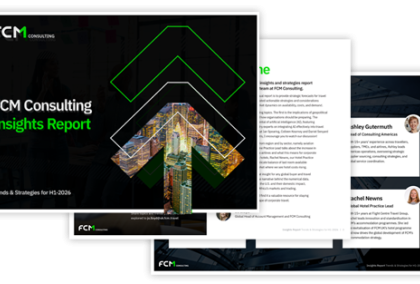
FCM Consulting has found that many companies are moving toward multi-department discipline risk ecosystems, linking human resources (HR), security, and travel for faster, centralised responses. Get more advice in FCM Consulting’s Insights Report H1-2026.

Trend 6: Airline ancillaries redefine value
Airlines have discovered their love language. Add-ons. Ancillary revenue, from seats to Wi-Fi and snacks, make up to 50% of airline income for some carriers, and is expected to hit USD 178 billion by 2032.
While base fare remain fundamental to an airlines pricing strategy, ancillary income has and will continue to become critical for profitability and program planning.
- Jason Kramer, FCM Consulting Senior Air Consultant.
For corporates, that means fare comparisons alone rarely represents the true value once a traveller adds all their extras. As 2026 progresses, travel managers will need to look beyond fare prices and measure total trip cost. Our FCM Consulting team recommends renegotiating contracts to bundle ancillaries. Combining priority boarding, lounge access, flexible change rules, or seat types and baggage for consistent value.

Trend 7: Hotels double down on experience
Hotels are reinventing themselves and we’re here for it. Boutique and mid-scale brands are leading this move with swanky in-room tech, curated business amenities, wellness centres, and personalised services. While traditional chains adapt with lifestyle offerings, loyalty programs, and a more focused customer service approach.
"Big hotel chains are starting to differentiate based on how customers pay, which impacts the initial booking and the entire travel program through to expense. Think flexible payment terms, corporate credit options, and billing structures that are unique to your finance team," says Nicola Ping, Global Manager of Travel Distribution at Flight Centre Travel Group.
Alternative lodging continues to rise too. GBTA corporate travel insights shows Airbnb and serviced apartments are gaining traction among corporate travellers seeking flexibility and a “home-away-from-home” feel, especially for longer regional stays. In 2026, rethink how you define “preferred accommodation.” Travellers value experiences and perks - hotel loyalty programs and perks still matter - but comfort and convenience now drive satisfaction more than brand.
Traveller preferences will drive hotels to offer more personalised experiences. Every company is different, so travel managers should understand their traveller needs and identify hotels that reflect those experiences.
- Rachel Newns, FCM Consulting Global Hotel Practice Lead.

Trend 8: The event experience economy
Meetings and events are taking up a larger slice of corporate travel budgets. Results from FCM Travel showed that over half of travel spend is expected to go towards conferences and gatherings. Companies are investing in internal collaboration and client-facing opportunities as face-to-face time regains its edge over virtual conferencing.
Event planners will also be laser focused on experiences and personalisation. Personalised content, custom agenda recommendations, and event apps will become standard audience offerings. Cvent data shows planners are chasing memorable moments through unique venues (49%), but it's the whole package, location, audience involvement, social elements, and incredible on-stage talent, that’ll create events people want to attend.
Buckle up and say hello to 2026
Similar reading...